Point-to-Point (PtP) Wireless Bridging


Trenching fiber-optic cable across an active parking lot, a public roadway, or rugged industrial terrain is frequently cost-prohibitive, delayed by complex municipal permitting cycles, or physically impossible. We deliver carrier-grade wireless backhaul links that provide fiber-like gigabit throughput between buildings, remote gates, and distant operational outposts without the prohibitive civil engineering overhead.
Whether you need to extend your corporate local area network (LAN) to a newly acquired facility, blanket an industrial logistics yard with high-speed connectivity, or backhaul high-resolution streams from perimeter security cameras, our team designs, deploys, and optimizes directional radio frequency (RF) bridges engineered to maintain absolute link stability under any operational load.
The YesTechie Engineering Standard: Carrier-Grade Wireless Infrastructure
Our team brings Internet Service Provider (ISP) level expertise to commercial wireless architecture. We do not simply point pre-configured antennas at each other. We treat the open air between your facilities as a critical data pathway, mapping out physical, environmental, and spectral constraints long before any hardware is mounted to your roofs.
As a licensed C-7 low-voltage contractor, YesTechie delivers structural accountability and technical precision:
- Licensed Structural Mounting: Installing high-frequency radios on commercial roofs requires piercing building perimeters and mounting heavy galvanized steel masts. Our team is fully bonded and insured, assuming complete financial liability for the integrity of your facilities during installation.
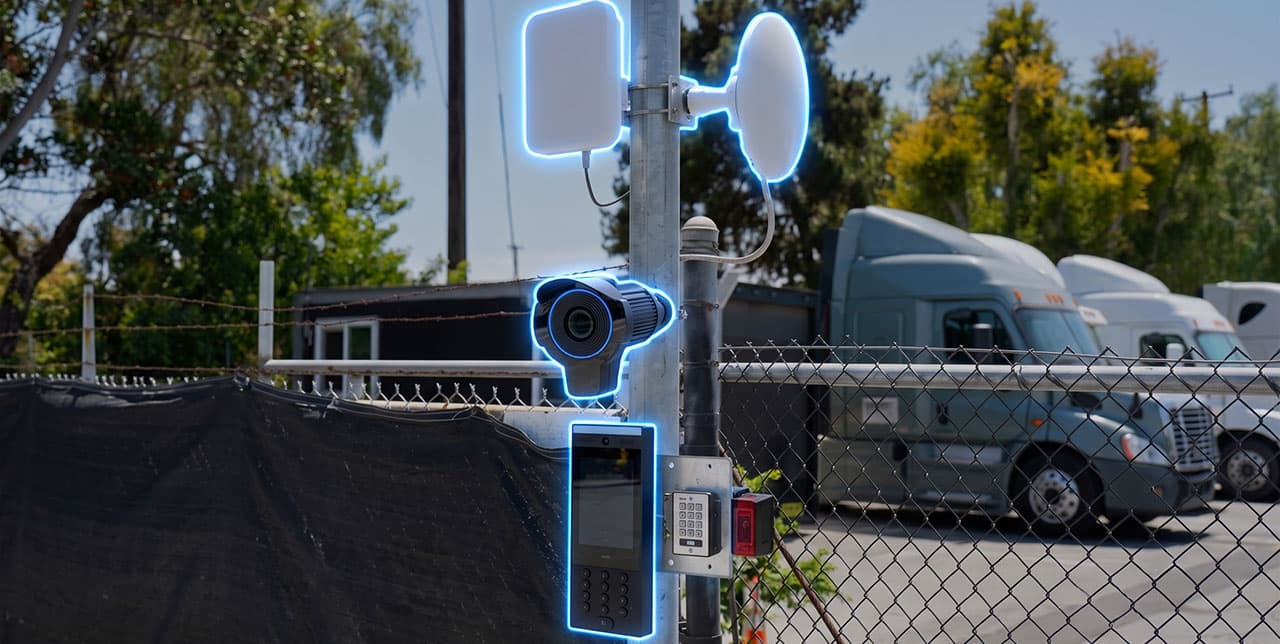
- Active Threat and Liability Mitigation: We design wireless backhauls to protect your business assets. By establishing high-throughput wireless links to remote perimeters, we allow your management team to deploy real-time AI security cameras, automated gates, and license plate recognition (LPR) sensors at your outermost property lines, stopping external security threats before they reach your main infrastructure.

What the Service Entails: Step-by-Step Engineering Process
Commercial wireless bridging is a highly structured, engineering-driven process that converts an open physical gap into a stable, high-throughput digital pipeline.
1. RF Spectrum and Line-of-Sight (LoS) Engineering
We eliminate all deployment guesswork through a rigorous physical and digital analysis of your environment before selecting hardware.
- Fresnel Zone Calculations: We map the exact elevation profile between your structures, calculating the 3D elliptical space required for the RF signal to propagate. We account for building rooflines, future tree growth, and Earth curvature on long-distance links to ensure the signal propagates without signal deflection.
- Spectrum Analysis and Channel Planning: We conduct active radio frequency scans at both site coordinates to identify local wireless congestion. This diagnostic process allows us to select completely clean operational frequencies and plan optimal channel widths, preventing interference from neighboring commercial networks.
2. Network Topology and Link Design
This phase establishes the logical blueprint of the wireless bridge to ensure it seamlessly handles multi-system data loads without introducing network bottlenecks.
- Point-to-Point (PtP) Links: Dedicated high-speed wireless pipelines connecting two distinct buildings. This architecture acts as an invisible, high-capacity Ethernet cable spanning distances from a few hundred feet to multiple miles, fully supporting bandwidth-heavy operations like cross-site database synchronization and real-time unified communications.
- Point-to-Multipoint (PtMP) Sectors: A centralized base station broadcasting to multiple remote receiving nodes. This is the premier topology for wide warehouse yards, logistics docks, and corporate campuses, allowing us to distribute secure network access to multiple remote guard shacks or outbuildings from a single master node.
- Traffic Prioritization and Quality of Service (QoS): We configure strict QoS rules at the bridge edge. Time-sensitive business data, such as corporate VoIP lines, real-time video conferencing, and access control credential logging, always receives priority over standard internet traffic during peak utilization periods.
3. Structural Rigging, Alignment, and Hardening
Wireless bridges fail when hardware shifts in high winds or succumbs to electrical surges. We deploy heavy-duty physical layers engineered to withstand extreme environmental stress.
- Precision Alignment and Wind-Loading Prevention: High-frequency millimeter-wave beams are incredibly narrow and can lose connection if the hardware shifts even a fraction of an inch. We secure all radios using heavy-duty, reinforced mounting masts engineered to withstand severe wind loads without losing micro-alignment.
- Surge Suppression and Grounding: Outdoor mast-mounted electronics are primary targets for lightning strikes and static buildup. We utilize high-grade shielded, outdoor-rated cabling and install dedicated industrial Ethernet surge protectors supporting modern multi-gigabit network profiles at the building entry points to guarantee comprehensive static and overvoltage defense for your core switches.
4. Validation, Performance Testing, and Handover
Before the link goes live, we conduct rigorous verification testing to confirm that the wireless throughput matches physical cable expectations.
- Throughput and Stress Testing: We run active capacity tests across the bridge, validating real-world throughput, latency, jitter, and packet loss metrics under heavy simulated data loads.
- Link Redundant Verification: For critical multi-gigabit connections, we deploy dual-radio architectures featuring a primary ultra-high-frequency radio backed by an automated secondary frequency. We execute physical failover tests to confirm that if severe weather causes rain fade on the primary beam, traffic instantly shifts to the backup link without dropping active network sessions. Handover includes complete as-built documentation, satellite path charts, and localized configuration backups.
The Market Shift and Our Engineering Philosophy
The commercial IT and network infrastructure landscape is experiencing a massive industry transformation. For decades, the market has been dominated by a restrictive, rent-seeking model. Traditional Managed Service Providers (MSPs) and legacy network vendors push subscription-heavy platforms because their business model relies on securing up to 40% commissions on recurring software licenses. Under this outdated paradigm, businesses are forced into a continuous cycle of operational expense, often paying tens of thousands of dollars annually just to keep their physical routing and bridging hardware functioning. If you stop paying this recurring software tax, your network backbone is artificially disabled.
Furthermore, enterprise clients are facing strict new geopolitical and compliance mandates. Businesses and municipal institutions are actively replacing unverified overseas hardware due to severe cybersecurity vulnerabilities. Modern enterprises now demand strict data sovereignty and verifiable Certificates of Origin to ensure their core infrastructure is completely free from foreign manipulation.

Sourcing the Ideal Solution: The Ubiquiti Advantage (UniFi & UISP)
Driven by this market trajectory, we architect our advanced wireless backhaul solutions around the Ubiquiti UniFi and UISP ecosystems. We advocate for this American-based brand because it acts as a massive industry disruptor, aligning perfectly with our engineering philosophy and your financial interests:
- Zero Recurring Licensing Fees: Ubiquiti delivers uncompromising enterprise bridging capabilities, advanced spectral analysis, and intuitive visual interfaces with absolutely no ongoing software subscriptions. You purchase the physical hardware once, and you own your data transmission and management software permanently. This eliminates the massive financial drain associated with legacy enterprise brands.
- Verified American Origin Security: As a prominent US technology brand, Ubiquiti hardware satisfies the stringent compliance, privacy, and security requirements demanded by corporate headquarters, municipalities, and heavily regulated commercial facilities.
- Absolute Data Sovereignty: Instead of routing your sensitive internal business traffic and telemetry through vulnerable third-party cloud controllers, the ecosystem processes routing data completely on-site. Your network traffic remains strictly under your physical control.
Bridging the Support Gap: The YesTechie Integrator Advantage
When a disruptive technology platform eliminates recurring vendor fees, it also eliminates traditional, expensive vendor-direct support contracts. Ubiquiti provides incredible hardware and software, but the operational responsibility of designing, deploying, aligning, and maintaining that system falls entirely on the business. For companies that require flawless uptime but do not want to hire a full-time RF network engineer, this creates a critical support gap.
YesTechie fills this exact operational gap. We do not operate as traditional MSPs trying to lock you into software licenses, nor are we simple low-voltage installers who just mount antennas and walk away. As Professional Integrators, we provide the dedicated engineering layer your business needs.
We correctly calculate your RF Fresnel zones, deploy the hardware to strict commercial codes, and offer completely flexible support models. Whether you need on-demand hourly troubleshooting or a strict Service Level Agreement (SLA) guaranteeing 24-hour hardware replacement from our local Los Angeles inventory, we deliver the professional support you require without the forced software tax.
Sourcing the Ideal Solution: UniFi vs. UISP Architectures
While physical copper and fiber links remain the absolute benchmark for infrastructure stability, wireless bridging serves as the definitive alternative when trenching is non-viable. As Certified Ubiquiti Integrators, we evaluate your specific distance requirements and existing tech stack to source the perfect hardware architecture:
The UniFi Bridge Ecosystem (Short-Hop, Multi-Device & Simplified Management)
For properties where remote buildings and security assets must stay integrated within your primary corporate network dashboard, we install UniFi-managed bridging hardware. We deploy solutions from two primary sub-series based on the deployment blueprint:
Building Bridging Series (PtP Network Extensions)
- Enterprise Building Bridging (Building Bridge XG): For heavy-traffic corporate offices, we deploy the UBB-XG. This 60 GHz point-to-point link acts as an invisible fiber optic connection, delivering a massive 10G SFP+ uplink with an automated 5 GHz backup radio, ensuring uninterrupted multi-gigabit performance across adjacent buildings with absolutely zero recurring license fees.
- Flexible Single-Unit Building Bridges: Rather than relying on rigid factory-paired kits, we deploy individual building bridge units that can be instantly paired and re-paired via software, providing unprecedented architectural flexibility during facility reconfigurations.
Device Bridging Series (Wireless Edge Hardware Deployment)
- Device Bridge Pro Sector: For expansive warehouse yards, commercial loading zones, or multi-site layouts, we deploy this 5 GHz point-to-multipoint access point. It allows us to wirelessly bridge 50+ remote Device Bridge Pro client units across stable, high-capacity links at distances extending up to 5+ km, completely bypassing the cost of fiber trenching.
- Device Bridge Switch: When an isolated section of a facility requires local network deployment but lacks a physical wire path, we install this fully wireless, high-performance network hub. Operating across 5 GHz and 60 GHz frequencies, it delivers multi-gigabit wireless backhaul throughput up to 5.8 Gbps while providing one 10 GbE port and seven 2.5 GbE ports locally to connect multiple wired assets like workstations and cameras.
- Device Bridge IoT: The most compact bridging solution yet, this ultra-compact device operates over 2.4 GHz frequencies to securely extend network access to standalone IoT assets. With highly flexible power methods including USB Type-C, 4-pin DC (9–30V DC), or a standard DC jack, it allows us to easily provision remote entry readers or environment sensors at the absolute edge of your property.

The UISP Operator Platform (Long-Range & Multi-Mile Infrastructure)
For massive distances, industrial carrier networks, and municipal telemetry, we deploy specialized, high-capacity Ubiquiti Internet Service Provider (UISP) hardware.
- Wave Millimeter-Wave MLO Technology: Utilizing advanced multi-link operation (MLO) across 60 GHz bands, Wave hardware delivers unparalleled throughput and ultra-low latency for multi-mile remote industrial facilities, such as commercial quarries or separate logistics plants.
- airFiber Point-to-Point Systems: Engineered for high-load real-time applications, airFiber systems deliver over 2 Gbps of full-duplex throughput across long physical distances, utilizing integrated GPS synchronization and dedicated spectral analysis radios to maintain stable connections even in adverse weather.
- LTU and airMAX Point-to-Multipoint Networks: We build wide-area multi-point sectors capable of wirelessly bridging up to 100+ remote client nodes over a multi-kilometer footprint, making it the premier choice for large public utility yards, transit authorities, and open commercial facilities.

Real-World Application: Municipal SCADA Networks
Our wireless architectures are proven across high-stakes commercial environments where physical cabling is logistically impossible. In our multi-site municipal infrastructure deployments, such as the Culver City Supervisory Control and Data Acquisition (SCADA) communication network, we bypassed over $200,000 in traditional fiber excavation and city permitting costs by engineering a long-range UISP wireless backhaul topology.
By mounting Wave AP master sectors and high-gain Wave Long-Range receiving nodes on specialized structural towers, we established a resilient 2 Gbps wireless backbone spanning a 3.5-mile cross-city trajectory. We reinforced this municipal infrastructure with redundant PtP links utilizing airFiber 60 Long-Range hardware connected directly to the city hall. This configuration guarantees 99.9% uptime for critical telemetry data and secure automated system synchronization across all distribution stations.
Proven Footprint Across Demanding Industries
Commercial wireless backhaul is never a one-size-fits-all deployment. As a licensed C-7 low-voltage contractor and Certified Ubiquiti Integrator, YesTechie has engineered and installed robust, high-capacity RF links across a diverse range of specialized business sectors throughout the United States:
- Industrial Logistics and Warehousing: Where massive physical yards require continuous connectivity. We deploy Point-to-Multipoint (PtMP) sectors to blanket staging areas with network access and securely bridge remote guard shacks back to the main security dashboard without trenching through concrete.
- Municipal Infrastructure and Utilities: Where public right-of-ways make physical fiber deployment impossible. We engineer multi-mile millimeter-wave backhauls to synchronize critical SCADA telemetry, traffic management systems, and public utility data across entire cities with 99.9% uptime.
- Expansive Corporate and Agricultural Campuses: Where data must cross vast open spaces. We deploy multi-gigabit PtP links to connect newly acquired buildings, remote production facilities, and outbuildings, creating a single, unified Local Area Network (LAN) directly over the air.
An enterprise wireless network is an evolving communication perimeter. YesTechie builds your topology to scale alongside your facility expansion and operational growth. To ensure your RF links remain completely secure, perfectly aligned, and free from spectral interference long after the initial deployment, we back our physical installations with dedicated technical support. Explore our Managed IT Services to learn more about our proactive maintenance plans, spectral monitoring, and automated firmware optimization.
If you need to connect a newly acquired building, bypass exorbitant fiber trenching costs, or expand your network to remote security assets, contact YesTechie today to schedule a comprehensive Line-of-Sight (LoS) assessment and RF layout audit.
Nationwide B2B Deployment & Enterprise Integration
While our engineering headquarters operates out of Los Angeles, the YesTechie integration team deploys hyperscale wireless bridging infrastructure for commercial enterprises across the United States. We partner exclusively with organizations where network stability, telemetry synchronization, and remote physical security are the critical foundations of daily operations.
Our wireless deployments span massive industrial logistics yards, multi-site corporate campuses, and complex municipal SCADA networks. We do not operate as simple antenna installers. We architect converged, high-throughput RF backhauls designed to withstand severe environmental stress, ensuring your remote facilities remain permanently connected without the exorbitant delays of traditional civil engineering and fiber trenching.
FAQ
Why should we use a wireless bridge instead of trenching fiber optic cable?
Trenching fiber optic cable across parking lots or public streets requires massive capital investments, heavy civil engineering equipment, asphalt destruction, and months of waiting for municipal building permits. A wireless bridge provides identical gigabit data speeds and near-zero latency across the exact same distance, but can be fully engineered, mounted, and activated by our team in a fraction of the time at a fraction of the cost.
How secure is data transmitted over an outdoor wireless bridge?
The data link layer is highly secure. Modern enterprise wireless bridges do not broadcast a wide Wi-Fi signal for anyone to join; instead, they utilize advanced proprietary long-range wireless protocols focused into an incredibly narrow, invisible directional beam between two specific physical coordinates. Combined with military-grade AES hardware encryption, the signal cannot be intercepted, manipulated, or accessed by outside devices, satisfying strict corporate compliance standards.
What is the difference between the Building Bridging and Device Bridging series?
The Building Bridging series is optimized to create high-throughput point-to-point network baselines between separate facilities, utilizing ultra-high-speed 10G connections to act as an invisible fiber drop. The Device Bridging series is engineered for agile edge-device deployment, allowing us to wirelessly link up to 50+ remote hubs, wireless network switches, or compact IoT modules across distances up to 5+ km back to a centralized network without running local cables.
What is automated directional Auto-Link technology and how does it simplify installation?
This intelligent deployment technology eliminates complex manual backend network programming. Once our engineers physically mount and align the hardware, the devices securely establish wireless handshakes using proprietary algorithms and integrate themselves into your centralized dashboard automatically, allowing for seamless ongoing management without software friction.
Are there monthly subscription costs or operator licenses required for these wireless links?
No. The enterprise hardware lines we deploy operate entirely within unlicensed frequency bands (such as 2.4 GHz, 5 GHz, and 60 GHz) that are completely free to use for commercial businesses under FCC regulations. Because YesTechie specializes in license-free ecosystems, you buy the physical bridging hardware once and own its full operational capacity permanently, completely eliminating ongoing service fees or vendor contract taxes.
Will heavy rain or extreme weather cause our wireless bridge to drop the connection?
We engineer our high-capacity links with automated failover redundancy. While severe weather can cause rain fade on ultra-high-frequency 60 GHz bands, our enterprise architectures feature a secondary 5 GHz backup radio. If the primary beam degrades, traffic instantly shifts to the backup frequency without dropping active network sessions, guaranteeing continuous uptime in adverse weather.
What if we lease our building and the landlord restricts roof penetrations?
As a licensed C-7 contractor, we deploy non-penetrating roof mounts (NPRM) using calculated ballast blocks. This allows us to safely secure heavy-duty steel masts and millimeter-wave radios in your building to withstand strict wind-load requirements without drilling a single hole into the roof membrane, preserving your commercial lease agreements.
Is wireless bridging latency too high for VoIP phone systems and live security cameras?
No. Modern enterprise wireless backhauls operate with sub-millisecond latency, functioning identically to a physical fiber optic cable. We also configure strict Quality of Service (QoS) rules at the network edge to prioritize time-sensitive data, ensuring voice calls and 4K video streams remain perfectly stable even under heavy local network loads.
Can you install a wireless bridge at a remote gate that lacks standard electrical power?
Yes. For remote perimeter chokepoints or guard shacks lacking utility power, we deploy specialized solar-powered enclosures paired with industrial battery banks. This creates a completely autonomous, off-grid network node capable of powering the wireless receiver, access control readers, and PoE security cameras continuously.
If the antennas get knocked out of alignment by a severe storm, how is it fixed?
Our remote telemetry dashboards actively monitor link signal-to-noise ratios in real time. If an antenna shifts even a fraction of an inch and degrades performance, we receive an instant automated alert. We then dispatch our engineering team to physically re-align and re-torque the hardware to exact micro-coordinates, restoring optimal multi-gigabit throughput.